

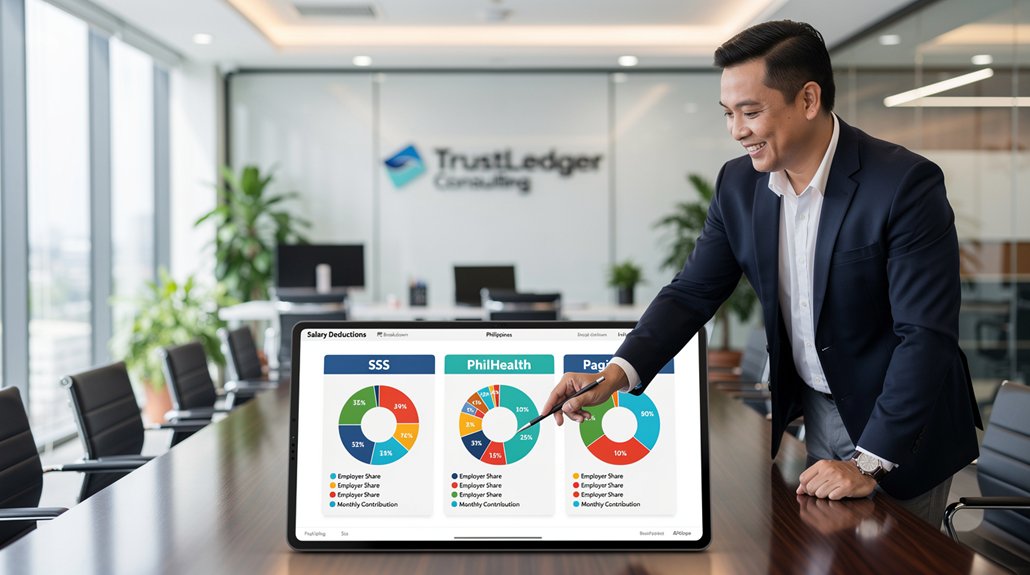
You’ll see three statutory deductions from your gross pay: SSS, PhilHealth, and Pag‑IBIG. SSS uses a Salary Credit (MSC) of PHP 5,000‑35,000, charging you 4.5 % (up to PHP 1,575) and your employer 9.5 % (up to PHP 3,325) plus a PHP 10‑30 EC fee. PhilHealth takes 2.5 % of your basic salary, capped at PHP 2,500 each share, with a minimum of PHP 500. Pag‑IBIG is 2 % of salary up to PHP 10,000, maxing out at PHP 200 per party. All three are subtracted before withholding tax, lowering your taxable income. If you keep going, you’ll see how the ceiling affects high earners and the exact payroll steps.
Highlights
- SSS, PhilHealth, and Pag‑IBIG are mandatory payroll deductions that lower taxable income before withholding tax is applied.
- SSS contributions are based on Monthly Salary Credit (MSC) with employee 4.5 % (max PHP 1,575) and employer 9.5 % (max PHP 3,325) plus an EC fee of PHP 10 or PHP 30.
- PhilHealth premium is 5 % of basic salary, split 2.5 % each; employee and employer shares are capped at PHP 2,500 each for salaries above PHP 100,000.
- Pag‑IBIG contributions are fixed at PHP 200 per employee and PHP 100 per employer for salaries above PHP 5,000, with a total cap of PHP 400 per employee.
- The deduction order is Pag‑IBIG first, then SSS, then PhilHealth; all must be remitted by the 10th of the following month to avoid penalties.
What Are the Three Mandatory Payroll Deductions in the Philippines?
Although you might think payroll deductions are a mystery, the Philippines mandates only three: Social Security System (SSS), PhilHealth, and Pag‑IBIG Fund (HDMF).
You’ll see SSS based on a monthly salary credit (MSC) from PHP 5,000 to PHP 35,000; employee share is 4.5 % (5 % for expatriates) and employer share 9.5 % (10 % for expatriates).
PhilHealth premiums equal 5 % of basic salary, split evenly, with a PHP 500 minimum and PHP 2,500 maximum per side up to the PHP 100,000 ceiling.
Pag‑IBIG caps the fund salary at PHP 10,000; employees pay 2 % (PHP 200) on earnings above PHP 1,500, and employers match up to PHP 200.
These deductions are excluded from gross compensation before taxable income is calculated, supporting retirement, health, and housing benefits.
Tracking benefit trends and integrating payroll automation helps you stay compliant and optimize cash flow.
Regular contributions are essential for maintaining active SSS membership and maximizing future benefits.
How Does the SSS Contribution Formula Work for Philippines Payroll Deductions?
You’ll first determine the Monthly Salary Credit (MSC) from the 2026 table, which caps at PHP 35,000.
Then apply 4.5 % (or 5 % for expatriates) for the employee share and 9.5 % (or 10 % for expatriates) for the employer share, respecting the PHP 1,750 and PHP 3,530 caps respectively.
Self‑employed contributors use a flat 15 % rate on the same MSC range.
A missed payment incurs a 3 % monthly penalty that compounds each month.
Salary Credit Determination
If you’re calculating SSS deductions, start with the Monthly Salary Credit (MSC), which is set by government‑approved brackets ranging from PHP 5,000 to PHP 35,000 for 2026.
You locate the bracket that matches your gross pay; that figure becomes your MSC.
The contribution rate applies to the MSC, not the actual salary, so a PHP 20,000 MSC yields a 4.5 % employee share of PHP 900 and a 9.5 % employer share of PHP 1,900.
When your salary exceeds the MSC ceiling of PHP 35,000, the contribution freezes at the ceiling amount, lowering the effective contribution rate for high earners.
Employer and Employee Shares
Because SSS contributions hinge on the Monthly Salary Credit (MSC), the employer’s share is 9.5 % of the MSC for local employees (10 % for expatriates) plus a PHP 10 compensation fee—or PHP 30 when the MSC exceeds PHP 14,500—while the employee’s share is a flat 4.5 % (5 % for expatriates) of the same MSC. You’ll see employee share trends stay consistent because the rate doesn’t vary with salary, and contribution timing aligns with each payroll cycle, deducted before tax.
| Category | Rate | Additional Fee |
|---|---|---|
| Local Employer | 9.5 % | PHP 10 (or PHP 30 > 14,500) |
| Expat Employer | 10 % | PHP 10 (or PHP 30 > 14,500) |
| Local Employee | 4.5 % | None |
| Expat Employee | 5 % | None |
| Self‑Employed | 15 % | None |
Understanding these splits lets you forecast cash‑flow impact and guarantee compliant payroll processing.
Caps and Contribution Limits
When the Monthly Salary Credit (MSC) hits the 2026 ceiling of PHP 35,000, both employee and employer contributions stop rising, locking the employee share at PHP 1,750 (4.5 % of MSC) and the employer share at PHP 3,530 (9.5 % of MSC) plus the EC premium—PHP 10 or PHP 30 if MSC exceeds PHP 14,500.
This ceiling enforcement means any salary above PHP 35,000 yields the same fixed contributions, simplifying contribution tracking for payroll systems.
The employee rate stays at 4.5 % (5 % for expatriates) up to the ceiling, while the employer rate is 9.5 % (10 % for expatriates) plus the EC amount.
Effectively, the total SSS rate is 14 % of MSC, but the cap reduces the effective percentage for high earners, ensuring predictable budgeting and compliance.
When Does the SSS Salary Credit Hit Its Ceiling and What Does That Mean for High Earners?
When your monthly salary exceeds PHP 35,000, the SSS salary credit caps at that amount, so your contribution stays at 4.5 % of PHP 35,000 (PHP 1,575) and your employer’s at 9.5 % (PHP 3,325).
This means any extra earnings beyond the ceiling won’t increase your SSS deductions or future benefit calculations.
For self‑employed workers the same ceiling applies, but you’ll pay the full 15 % on PHP 35,000, maxing out at PHP 5,250 per month.
The contribution tables are updated annually to reflect inflation adjustments.
Salary Credit Ceiling Trigger
If your monthly gross pay reaches PHP 35,000, the SSS Monthly Salary Credit (MSC) hits its 2026 ceiling, meaning both employee and employer contributions are capped at PHP 1,575 (4.5 % of MSC) and PHP 3,325 (9.5 % of MSC) respectively, while high earners’ effective contribution rate declines as their actual salary climbs above that threshold.
The ceiling timing is fixed; once you cross PHP 35,000, SSS withholding stays static, creating a clear high earner impact on payroll forecasting.
- MSC stops increasing at PHP 35,000.
- Employee share maxes at PHP 1,575.
- Employer share maxes at PHP 3,325.
- EC surcharge caps at PHP 30 for MSC > PHP 14,500.
No extra SSS cost accrues beyond the ceiling, so salary bumps above the threshold affect only net pay, not contributions.
Impact on Contribution Caps
Although the SSS Monthly Salary Credit (MSC) caps at PHP 35,000 for 2026, any salary above that level no longer raises the 4.5 % employee share (or 5 % for expatriates) or the 9.5 % employer share (10 % for expatriates), which max out at PHP 1,750 and PHP 3,530 respectively.
When your earnings exceed the ceiling, your total SSS out stays fixed at those caps while your net pay climbs, creating a contribution‑rate dilution.
For high‑earner impact, this means the effective percentage of gross salary devoted to SSS drops as income rises, though benefits remain tied to the capped MSC.
The ceiling’s rise from PHP 30,000 in 2025 to PHP 35,000 in 2026 postpones the cap point, giving high earners a longer window before dilution sets in.
How Is the PhilHealth Premium Calculated for Philippines Payroll Deductions?
Because PhilHealth premiums are calculated as a fixed percentage of basic salary, you can determine the exact amount by applying the 2.5 % employee share (and the same for the employer) to the employee’s monthly basic pay, then rounding to the nearest peso—subject to a minimum of PHP 500 per share for salaries under PHP 10,000 and a maximum of PHP 2,500 per share when the salary exceeds the PHP 100,000 ceiling.
This method also defines PhilHealth eligibility and the contribution timing, as both parties must remit their shares by the 10th of the following month, with a 2 % penalty for late payments.
- Verify basic salary falls within the PHP 10,000‑PHP 100,000 range.
- Compute 2.5 % of that salary for employee and employer shares.
- Apply the PHP 500 minimum or PHP 2,500 maximum caps as needed.
- Round each share to the nearest peso and schedule remittance by the 10th.
The 2024‑2025 rate increase to 5 % reflects the program’s evolving financing needs.
What Are the Pag‑IBIG Contribution Rates for Different Salary Brackets?
PhilHealth premiums are calculated as a fixed percentage of basic salary, and the next piece of the payroll puzzle is the Pag‑IBIG contribution.
You’ll find three Pag‑IBIG tiers based on monthly salary.
Tier 1 covers up to PHP 1,500: you pay 1 % (capped at PHP 200) and your employer 2 % (capped at PHP 400).
Tier 2 spans PHP 1,501‑PHP 5,000: both employee and employer contribute 2 % each, with a contribution caps of PHP 200 per party.
Tier 3 applies above PHP 5,000: contributions stay fixed at PHP 200 each because the maximum fund salary for computation is capped at PHP 10,000.
Self‑employed members follow the same 1 %‑2 % schedule with a PHP 200 monthly ceiling.
Consequently, total Pag‑IBIG outlay tops out at PHP 400 per employee per month. This ensures consistent budgeting for Filipino workers across income levels.
How Do SSS, PhilHealth, and Pag‑IBIG Contributions Together Affect Net Salary and Withholding?
If you look at a typical payroll run, the employee’s SSS, PhilHealth, and Pag‑IBIG deductions are taken out of gross pay before any tax is calculated, which instantly lowers the taxable base.
A PHP 30,000 salary shows PHP 1,350 SSS, PHP 600 PhilHealth, and PHP 200 Pag‑IBIG, leaving PHP 27,850 for withholding.
The combined mandatory contributions occupy 5–7 % of gross, but caps shrink the effective rate for higher earners, shaping ded impact trends.
Employers must first apply the fixed PHP 200 Pag‑IBIG, then SSS based on MSC, then PhilHealth capped at PHP 2,500, before BIR tables, highlighting compliance challenges.
- Fixed Pag‑IBIG deduction
- SSS employee share (4.5 % of MSC)
- PhilHealth premium (2.5 % up to PHP 2,500)
- Adjusted taxable compensation for withholding
The 2025 SSS rate increase also raises the employee contribution to 5 % of MSC.
How Do Mandatory Payroll Deductions Differ From Voluntary Ones for Tax Reporting?
When you compare mandatory payroll deductions—SSS, PhilHealth, and Pag‑IBIG—to voluntary ones, the key difference is how they affect taxable income: mandatory contributions are subtracted from gross pay before tax is computed, while voluntary deductions are applied after tax, acting as post‑tax reductions.
Mandatory shares (SSS 4.5 % of MSC, PhilHealth 1‑2 % up to PHP 100 k, Pag‑IBIG 2 % up to PHP 10 k) lower the taxable compensation figure and appear on BIR Form 1604‑C/1604‑E as exclusions. Voluntary deductions, unless they meet specific BIR criteria, are listed under allowable deductions after tax.
Employers must remit mandatory contributions each payroll cycle; voluntary deductions are remitted only with employee authorization. Correct tax classification prevents over‑ or under‑withholding, and both categories must meet reporting deadlines to avoid penalties.
What Steps Compute a Sample Payroll Net‑Pay Using SSS, PhilHealth, and Pag‑IBIG Rates?
You start with the employee’s gross salary, then subtract the SSS (4.5 % of MSC), PhilHealth (2.5 % of basic salary up to PHP 2,500), and Pag‑IBIG (2 % up to PHP 10,000) contributions.
The remaining amount is your taxable compensation, which you feed into the withholding‑tax table.
Finally, deduct the calculated tax to arrive at the net‑pay.
Determine Gross Salary
Understanding how to compute a sample payroll’s net‑pay starts with identifying the employee’s gross salary, then applying the statutory deductions for SSS, PhilHealth, and Pag‑IBIG.
First, pin down the basic salary; this determines the Monthly Salary Credit (MSC) and directly influences salary credit trends and pension eligibility.
Next, calculate each contribution using the MSC and basic salary caps.
Finally, subtract the employee’s shares to get taxable compensation before withholding tax.
- Match basic salary to the 2026 MSC bracket (PHP 5,000‑35,000).
- Compute SSS share: 4.5 % × MSC for locals.
- Compute PhilHealth share: 5 % × basic salary, split 2.5 % each, bounded by PHP 500‑2,500.
- Compute Pag‑IBIG share: 2 % × basic salary, capped at PHP 200, with a PHP 200 minimum for salaries >PHP 1,500.
Apply Mandatory Contributions
Now that the gross salary and MSC are set, calculate each mandatory contribution before arriving at taxable compensation.
| Contribution | Employee Share |
|---|---|
| SSS | 4.5 % of MSC |
| PhilHealth | 2.5 % of basic salary (capped ₱2,500) |
| Pag‑IBIG | 2 % of salary up to ₱10,000 (capped ₱200) |
Apply the SSS rate to the MSC, then check vol deduction caps for PhilHealth and Pag‑IBIG. Subtract the three employee shares from gross pay to get taxable compensation. Make sure each figure respects the statutory caps; otherwise a compliance audit could flag the payroll. Use the resulting taxable compensation for withholding tax calculations in the next step.
Calculate Net Pay
Because the three mandatory contributions are already known, calculating net pay is just a matter of subtracting them from gross salary and then applying the withholding‑tax table to the resulting taxable compensation.
You’ll first determine the Monthly Salary Credit (MSC), then compute SSS (4.5 % of MSC), PhilHealth (2.5 % of basic salary, capped), and Pag‑IBIG (1 % or 2 % up to PHP 200).
Subtract those totals, look up the withholding tax, and arrive at net pay.
This process aligns with remote headline trends and supports deduction optimization.
- Identify MSC and basic salary.
- Calculate SSS, PhilHealth, Pag‑IBIG contributions.
- Subtract contributions from gross salary.
- Apply the withholding‑tax table to the reduced amount.
What Mistakes Do Employers Often Make With SSS, Philhealth, and Pag‑Ibig Filings?
When you calculate payroll, many employers mistakenly base SSS, PhilHealth, and Pag‑IBIG contributions on the employee’s actual gross salary instead of the government‑approved Monthly Salary Credit (MSC), which leads to over‑ or under‑payments.
You’ll often forget the 2025 SSS rate increase to a 15 % total (4.5 % employee, 9.5 % employer) and the new MSC ceiling of PHP 35,000, causing incorrect withholding.
Using the outdated Pag‑IBIG ceiling of PHP 5,000 rather than PHP 10,000 under‑pays the employer’s 2 % share for higher earners.
Ignoring PhilHealth’s PHP 100,000 cap (PHP 5,000 each share) creates excess deductions.
Missing the mandatory EC contribution of PHP 10 (or PHP 30 for MSC > PHP 14,500) with SSS filings triggers penalties.
Implementing deduction automation and strict employer compliance checks eliminates these errors.
What Checklist Ensures Compliance With 2026 Philippines Salary Deduction Rules?
If you want to stay compliant with the 2026 salary‑deduction rules, start by confirming each employee’s Monthly Salary Credit (MSC) falls between PHP 5,000 and PHP 35,000, then apply the correct SSS rates—9.5 % employer and 4.5 % employee for locals (10 %/5 % for expatriates).
Next, compute PhilHealth at 5 % of basic salary, split 1 % each, respecting the PHP 100,000 ceiling.
Then, apply Pag‑IBIG based on the PHP 10,000 max fund salary, using the 2 %/2 % caps for salaries above PHP 1,500 and 1 %/2 % below.
Finally, deduct these contributions before BIR tax calculations and remit by the 10th.
- Verify MSC range and SSS rates
- Calculate PhilHealth split and ceiling
- Apply Pag‑IBIG caps and percentages
- Use compliance automation to track deadlines and retain records for remote audit trends
Frequently Asked Questions
How Are Employer‑Paid Contributions Reflected on Employee Payslips?
Your payslip shows “Employer share” under the deductions column, coded as SSS, PhilHealth, or Pag‑IBIG contributions, each with its own payroll code indicating the amount the employer paid.
Can Overseas Filipino Workers (OFWS) Opt Out of Any Mandatory Deduction?
You can’t fully opt out, but OFWs often qualify for an OFW exemption or deduction waiver on SSS, PhilHealth, and Pag‑IBIG, reducing contributions while still maintaining basic coverage.
Do SSS, Philhealth, and Pag‑Ibig Contributions Affect Overtime Pay Calculations?
Yes, they don’t change overtime tax or contribution caps; overtime pay is calculated on your basic salary before deductions, so SSS, PhilHealth, and Pag‑IBIG contributions are applied after you’ve earned the overtime amount.
What Happens to Contributions if an Employee Resigns Mid‑Month?
When you resign mid‑month, your SSS, PhilHealth, and Pag‑IBIG contributions are prorated; you’ll receive midated benefits based on days worked, and any excess contributions are refunded or adjusted in the final pay.
Are There Penalties for Late Filing of Mandatory Payroll Deductions?
You’ll face penalty escalation if you miss filing deadlines; the government imposes daily fines that compound, so late payroll deduction reports quickly become costly and may trigger audits.