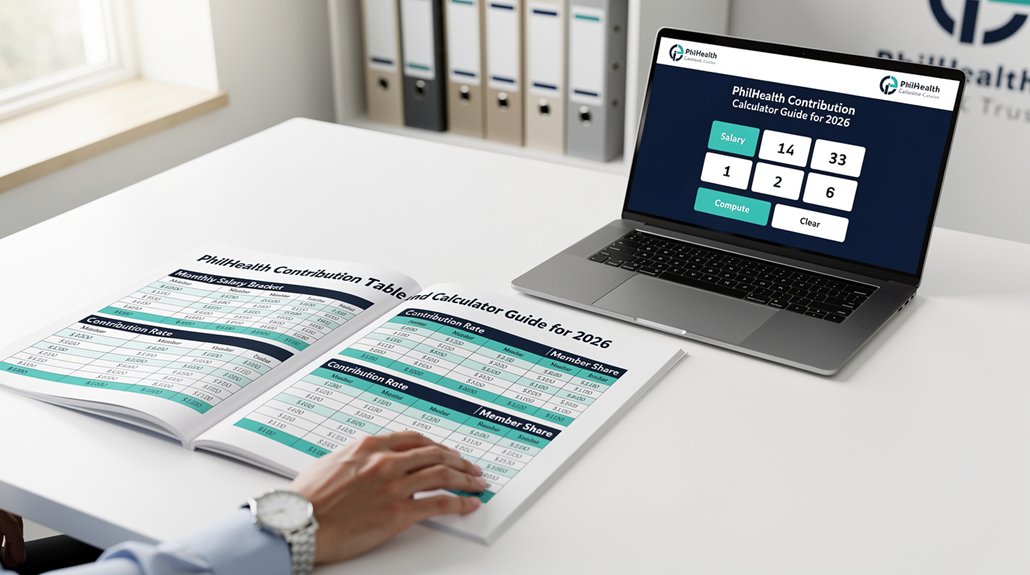


You’ll pay 2.5 % of your basic monthly salary to PhilHealth, and your employer matches that amount, making the total contribution 5 % of the eligible salary. Both shares have a ₱500 floor and a ₱2,500 ceiling, and the combined premium is capped at ₱5,000 even if your salary exceeds ₱100,000. Contributions must be remitted by the end of the following month, and late filings incur penalties and interest. Continue to discover detailed calculations, special‑case rules, and automation tools.
Highlights
- Premium is 5 % of the monthly salary, split equally: 2.5 % employee share, 2.5 % employer share.
- Salary ceiling of ₱100,000 caps contributions; total premium cannot exceed ₱5,000 (₱2,500 each).
- Minimum contribution per party is ₱500, so the combined minimum premium is ₱1,000.
- Contributions must be remitted by the last day of the month after the salary period, with penalties for late filing.
- Special cases: OFWs follow the same 5 % rule; kasambahay and indigent members have reduced or subsidized rates.
Health PhilHealth’s 5 % Contribution Rule: What It Means for You
Because the 2025 PhilHealth premium is fixed at 5 % of an employee’s basic monthly salary, you’ll see a straightforward split: 2.5 % comes out of your paycheck and the other 2.5 % is should by your employer, with contributions capped between ₱500 and ₱5,000 for salaries up to ₱100,000.
This policy guarantees uniform benefit eligibility across the formal workforce while respecting contribution limits that protect low‑income earners.
For a ₱30,000 salary, both parties contribute ₱750, illustrating the linear scaling until the ceiling.
Employers must remit the combined amount by the month‑end deadline; non‑compliance triggers ₱5,000‑10,000 penalties per employee.
Payroll systems must consequently embed the 5 % rule and generate distinct employee and employer entries each cycle, preserving data integrity and regulatory compliance.
The 2025 rate reflects the latest adjustment outlined in PhilHealth circulars.
PhilHealth 5 % Employee Share Calculation
How exactly is your PhilHealth employee share calculated?
The policy mandates a 5 % premium on your monthly basic salary or declared income, subject to a ₱100,000 ceiling.
You first determine salary eligibility by confirming that your base pay falls within the ceiling; any amount above ₱100,000 is excluded from the calculation.
Multiply the eligible salary by 0.05 to get the total premium, then apply the deductible breakdown: 50 % employee, 50 % employer.
For a ₱25,000 salary, the total premium is ₱1,250, and your share is ₱625 (2.5 %).
This amount is automatically deducted from your payroll before net pay is computed, ensuring compliance with the 2025 PhilHealth contribution rule.
SSS contribution rates have also risen to 15 % of the monthly salary credit, affecting overall payroll deductions.
Why Your Employer Pays the Same as You (Employer Share)
Why does your employer match your PhilHealth contribution? Because the 2025 rule sets the total premium at 5 % of basic salary, split evenly at 2.5 % each.
This 50‑50 split creates contribution fairness: workers aren’t overburdened, and the health fund receives steady inflows from both sides.
Employers must deduct the employee’s share and remit both portions together, facing ₱5,000‑₱10,000 penalties for non‑compliance.
The employer’s portion is recorded as a statutory payroll expense and qualifies for tax policy benefits, reducing taxable income as a deductible business cost.
Aligning with the Universal Health Care Law, the equal split sustains PhilHealth’s benefit pool and guarantees universal coverage without shifting costs disproportionately.
Regular contributions are essential for maintaining active membership and accessing future health benefits. Salary credit determines the exact amount each party pays.
500 Floor and ₱2,500 Ceiling for Each Party
When the monthly premium is calculated, each party’s contribution is bounded by a ₱500 floor and a ₱2,500 ceiling, regardless of whether the employee’s basic salary sits at the ₱10,000 minimum or exceeds the ₱100,000 ceiling.
This policy guarantees that the employee’s premium never falls below ₱500, while the contribution ceiling caps the share at ₱2,500.
The employer mirrors this structure, contributing the same minimum and maximum amounts.
Consequently, the combined premium ranges from ₱1,000 (both at the floor) to ₱5,000 (both at the ceiling).
The floor protects low‑income workers from unaffordable deductions, and the ceiling prevents excessive outlays for high‑earners, maintaining a predictable cost base for both parties.
Self‑employed contributions require a 15 % rate of the declared Monthly Salary Credit, with a ₱5,000‑₱35,000 range.
Capping Contributions at the ₱100,000 Salary Ceiling
Because the 2025 PhilHealth premium rate is set at 5 % of monthly basic salary but capped at a ₱100,000 salary ceiling, any earnings above that threshold don’t increase the contribution.
This cap creates a predictable maximum of ₱5,000 per month, split evenly between employee and employer, ensuring contribution fairness across income brackets.
It also limits premium ceiling variations, preventing disproportionate spikes for high‑income earners while preserving the policy’s progressive intent.
- Maximum premium – ₱5,000 total (₱2,500 each) once salary reaches ₱100,000.
- Below‑ceiling calculation – 5 % of actual salary, then halved for each party.
- Policy impact – stabilizes cash flow for firms, caps employee burden, and aligns with equity goals.
The capped contribution also aligns with the TRAIN Law exemption of the first ₱250,000 of annual income.
Remittance Timing for Employee & Employer Shares
You’ll notice the remittance deadline falls on the last day of the month after the contribution period, so timing is critical to avoid ₱5,000–₱10,000 penalties plus interest.
The policy mandates electronic filing via the PhilHealth portal or accredited providers for all 2025 contributions, with manual filing only as a fallback.
For self‑employed or voluntary members, the same deadline applies quarterly, reinforcing the need for a reliable payment method schedule.
Applicants must also meet the 36‑month contribution requirement to qualify for certain SSS benefit programs.
Remittance Deadline
If your company’s payroll period ends in March, the combined employee‑and‑employer PhilHealth share must be remitted by April 30, the last day of the following month.
You’ll notice that the law treats each contribution cycle as a strict deadline; missing it triggers remittance penalties ranging from ₱5,000 to ₱10,000 per employee, plus interest.
For self‑employed or voluntary members, quarterly deadlines—March 31, June 30, September 30, and December 31—apply, making compliance a recurring data‑driven task.
- Verify payroll deductions align with the employer’s added share before filing.
- Submit the electronic remittance report and payment together on the portal.
- Track penalty thresholds and interest accrual to avoid fiscal overruns.
Payment Method Options
When the payroll period closes, the employer must remit the combined PhilHealth premium—employee and employer shares—by the last day of the following month, and the choice of payment channel directly affects compliance risk and cost. You can use accredited banks, online methods, or E‑wallet options such as GCash, each with distinct processing times and fee structures. Data show that electronic channels cut settlement time by up to 48 hours compared with manual bank deposits, while late filing still triggers ₱5,000‑₱10,000 penalties per employee under Circular 003‑2015. Selecting a payroll service provider like Sprout can automate the filing, reducing human error and audit exposure.
| Channel | Processing Time | Typical Fee |
|---|---|---|
| Accredited Bank | 2‑3 business days | ₱150‑₱250 |
| Online Portal | 1‑2 business days | ₱100‑₱180 |
| E‑wallet (GCash) | Instant | ₱50‑₱120 |
| Payroll Provider | Same‑day | ₱200‑₱300 |
| Manual Cash | >3 days | ₱0 (high risk) |
Typical Errors in the 5 % Split and Penalty‑Avoidance Tips
Because the 5 % contribution must be calculated on the exact monthly income reported on the payroll register, any deviation—such as using the basic salary instead—creates immediate under‑ or over‑payments that trigger penalties.
You’ll see the most common errors stem from mis‑applying the split, using outdated rates, or ignoring the ceiling.
To keep pen‑deduction‑penalty risk low, adopt a systematic check‑list and automate deadline alerts.
- Verify that the payroll register reflects the declared monthly income, then split the 5 % evenly; avoid paying the full amount from the employee side, which can incur a ₱5,000‑10,000 penalty‑avoidance.
- Update your software to the 5 % formula; old 3.5 % or 2.75 % rates leave a shortfall of up to ₱250 per employee.
- Apply the correct ₱5,000 maximum contribution, not the ₱100,000 salary ceiling, and submit by the last day of the following month to prevent the 2 % surcharge and ₱5,000 penalty‑avoidance.
How OFWs, Kasambahays, and Indigent Members Are Treated
Although the classification of members varies, the policy framework treats OFWs, kasambahays, and indigent individuals distinctly. You’ll notice that OFWs are direct contributors, paying a 5 % premium on declared income with a ₱500‑₱5,000 range, while kasambahays benefit from a capped ₱250 premium that the employer fully absorbs for earnings ≤₱5,000 and splits 50‑50 for ₱5,001‑₱10,000. Indigent enrollment removes any payment requirement, granting free coverage to those identified by DSWD, including qualifying senior citizens and PWDs. The table below summarizes the treatment:
| Member Type | Premium Responsibility |
|---|---|
| OFW | 5 % of income (₱500‑₱5,000) |
| Kasambahay (≤₱5,000) | Employer pays ₱250 |
| Kasambahay (₱5,001‑₱10,000) | ₱125 each (employee & employer) |
| Indigent | No premium, fully subsidized |
These rules guarantee each group’s contribution aligns with income and eligibility criteria, reinforcing equitable access while maintaining fiscal discipline.
Using Sprout Payroll to Automate the 5 % Split and Stay Compliant
If you use Sprout Payroll, the system instantly computes the 5 % PhilHealth premium from each employee’s basic salary, applies the statutory 50/50 split, and caps the employer’s share at ₱2,500 for salaries above ₱100,000, ensuring every contribution stays within legal limits and is ready for electronic remittance by the 15th of the following month.
The platform’s automatic integration pulls salary data directly from your HRIS, while the compliance dashboard visualizes caps, penalties, and audit trails in real time.
By generating distinct line items for employee and employer shares, Sprout eliminates manual errors and guarantees timely filing.
- Real‑time alerts flag missed or late contributions, averting ₱5,000‑10,000 penalties.
- Downloadable summary supports BIR filing and audit verification.
- Premium ceiling updates automatically when salaries exceed ₱100,000, preserving statutory limits.
Frequently Asked Questions
Can I Opt Out of the 5% Contribution if I’M Self‑Employed?
You can’t opt out; self‑employed exemptions only apply when your income falls below contribution thresholds, so you must still pay the 5% rate unless you qualify for the low‑income waiver.
How Are Contributions Calculated for Part‑Time or Seasonal Workers?
You calculate contributions by applying the standard rate to the employee’s actual earnings, then adjust for part‑time eligibility and seasonal rate adjustments, ensuring both employer and employee shares reflect the reduced or fluctuating payroll.
What Happens if My Employer’s Payroll System Crashes During Remittance?
If your employer’s payroll system crashes, a remittance delay occurs; you should still be covered, but the employer must file an exception report, reconcile the system payroll failure, and submit the missed contributions within the statutory grace period to avoid penalties.
Do Overtime and Allowances Affect the Contribution Base?
Overtime impact and allowance inclusion raise your contribution base, so you’ll pay higher premiums. The policy treats both as taxable earnings, and PhilHealth calculates shares on the summed amount, increasing employer and employee contributions accordingly.
Is There a Grace Period for Late Philhealth Payments?
You have a 30‑day grace period for late PhilHealth payments; after that, penalties apply. Exemptions exist for senior citizens and low‑income earners, but otherwise interest accrues daily.