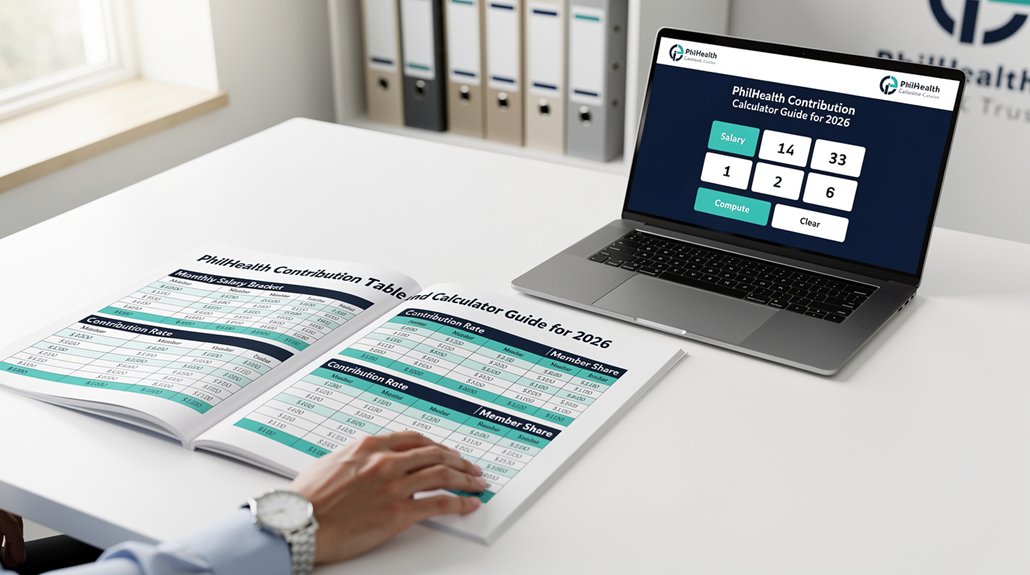


You’ll see that in 2026 Pag‑IBIG caps the total monthly contribution at ₱400. If your salary is ₱1,500 or less, you pay 1 % (max ₱15) and your employer adds 2 % (max ₱30). For salaries between ₱1,501 and ₱10,000, both sides contribute 2 % each, up to ₱200 per share. Earnings above ₱10,000 are fixed at ₱200 each. The table also covers voluntary and household members, and explains payment deadlines, penalties, and verification steps you’ll discover next.
Highlights
- Employee share is 1 % of salary up to ₱1,500 (max ₱15), then 2 % for ₱1,501‑₱10,000, capped at ₱200 for salaries above ₱10,000.
- Employer share is 2 % of salary, capped at ₱30 for ≤ ₱1,500, ₱200 for ₱1,501‑₱10,000, and ₱200 for salaries above ₱10,000.
- Total combined contribution per employee cannot exceed ₱400 per month (₱200 employee + ₱200 employer).
- Contributions are remitted by the 10th of the following month; late payments incur a 0.01 % daily penalty.
- Contribution records are viewable and exportable via the Pag‑IBIG Virtual Employer portal, showing monthly employee and employer shares.
2026 Salary Brackets & ₱100 Cap
Although the ₱100 cap only applies to the lowest salary bracket (≤ ₱1,500), the contribution structure quickly shifts once earnings exceed that threshold.
For salaries up to ₱1,500, you and your employer each pay 1% and 2% respectively, totaling ₱100 per month.
Once your pay moves into the ₱1,501‑₱10,000 range, both parties contribute 2% of the salary, but each share is limited by a ₱200 contribution limit, creating a combined ₱400 ceiling.
Above ₱10,000, the base is capped at ₱10,000, so you and your employer each contribute a fixed ₱200, maintaining the ₱400 total.
These salary caps and contribution limits guarantee predictable budgeting while scaling with earnings.
The new contribution rates also align with the SSS 15% rate to ensure consistent social security funding.
How Employees Compute Their 2 % Share Using the Pag‑IBIG Table 2026?
When you determine your Pag‑IBIG employee share, first compare your monthly salary to the 2026 ₱10,000 Maximum Fund Salary (MFS) cap; if your pay is ₱1,501–₱10,000, simply multiply the actual salary by 2 % (e.g., ₱6,500 × 0.02 = ₱130), and if it exceeds ₱10,000, the contribution is fixed at ₱200.
For salaries ₱1,500 or less, apply the 1 % rule (₱1,200 × 0.01 = ₱12). Once you have the correct amount, record it as your employee eligibility contribution.
Payroll systems must deduct this figure each pay cycle and remit it by the 10th of the following month, satisfying the mandated contribution timing. This data‑driven approach satisfying compliance and eliminates guesswork. Adding regular contributions also enhances future loan capacity within the Pag‑IBIG system.
How Employers Compute Their 2 % Share & Apply the ₱100 Cap?
After you’ve nailed the employee’s 2 % share, turn to the employer’s side: compute 2 % of each worker’s monthly salary but cap the base at the ₱10,000 Maximum Fund Salary, so any wage above that is treated as ₱10,000. The resulting figure is then capped at ₱200 per employee per month, replacing the old ₱100 cap. For low earners (≤ ₱1,500) you still apply the 2 % rate, yielding a maximum of ₱30. Record the amount as “Employer Share” and remit by the 10th of the following month. This analytical approach guarantees compliance and simplifies payroll processing. The SSS Contribution Calculator can help verify overall deductions.
| Salary Bracket | Employer Share |
|---|---|
| ≤ ₱1,500 | 2 % of salary (max ₱30) |
| ₱1,501‑₱10,000 | 2 % of salary (capped at ₱200) |
| > ₱10,000 | ₱200 (cap cap cap cap cap) |
2026 Pag‑IBIG Table Examples: Low, Mid‑Range, and High Salaries
If you break down the Pag‑IBIG contributions by salary tiers, the numbers line up neatly: a low earner earning ₱1,200 pays ₱12 (1 %) while the employer adds ₱24 (2 %), totaling ₱36.
At a mid‑range salary of ₱6,500, both parties contribute ₱130 (2 %), reaching ₱260 per month.
For high earners at ₱15,000, contributions hit capped variations: the employee and employer each pay the maximum ₱200, so the total stays at ₱400.
These data points illustrate clear contribution trends—low salaries follow the 1 %/2 % split, mid‑range salaries align with the flat 2 % rate, and any salary above the ₱10,000 MFS triggers the caps.
Understanding these patterns helps you forecast payroll expenses accurately and guarantees compliance with the 2026 Pag‑IBIG table.
User‑friendly interface simplifies navigating these calculators for all users.
Voluntary & Household Contributions in the 2026 Pag‑IBIG Table
You’ll notice that voluntary members must remit at least PHP 100 monthly, with any amount above that counted toward Provident Savings, while household employers only pay a 2 % employer share up to a PHP 10,000 salary base.
Both contributions are capped at PHP 400 per month (PHP 200 employee + PHP 200 employer) and must be submitted by the 10th day of the following month, otherwise a 0.01 % daily penalty applies.
These payments are recorded in your Pag‑IBIG account and directly affect eligibility for housing, calamity, and multi‑purpose loans.
A recent update introduced higher contribution ceilings for high‑earning members.
Voluntary Member Contributions
Because the 2026 Pag‑IBIG table caps voluntary contributions at PHP 200—the same ceiling applied to regular employees earning above PHP 10,000—members can remit any amount of PHP 100 or more, but anything beyond PHP 200 will be rejected.
This rule defines voluntary eligibility and contribution limits for anyone outside regular payroll.
You’ll see the contribution credited to the Provident Savings account, advancing your balance for MP2 and housing loans.
The system treats late payments uniformly: a daily penalty of 0.01 % accrues on the unpaid portion, mirroring regular member penalties.
No employer share is required for voluntary members, so the only variable you control is the amount you remit, which must stay within the PHP 100‑PHP 200 window to avoid rejection.
Household Employer Obligations
While voluntary members are limited to a PHP 100‑PHP 200 contribution window, household employers face a distinct set of rules.
You must remit a 2 % household tax on the domestic worker’s monthly salary, with no employee share.
The cap is PHP 200 per month once the salary exceeds the PHP 10,000 maximum fund salary, so your maximum payment never exceeds PHP 200.
Payments are due on or before the 10th day of the following month, using the same channels as regular employers: over‑the‑counter at Pag‑IBIG offices or accredited banks, Virtual Pag‑IBIG, or mobile apps.
Late payments incur a daily 0.01 % penalty, and persistent delinquency can suspend the worker’s benefit eligibility for Pag‑IBIG loans.
When and How Should Employers Pay Their Contributions?
When the payroll period ends, employers must remit the combined Pag‑IBIG contribution—employee share (2 % of salary up to ₱10,000) plus employer share (2 % of salary up to the same cap), each capped at ₱200—by the 10th day of the following month.
Payment deadlines are strict; missing them triggers compliance checks.
Use the Virtual Pag‑IBIG for Employers portal to generate a PRN or SOA, then select a payment method: accredited bank transfer, over‑the‑counter counter, online card, or mobile app (GCash, Shopee).
Record the PRN, retain the receipt, and update payroll to reflect the employee’s deducted share.
This workflow guarantees accurate reporting, avoids penalties, and preserves employee loan eligibility.
Employers can also monitor payment status in real‑time through the portal’s contribution tracking feature.
Late‑Payment Penalties and Their Effect on Loan Eligibility
If you miss a Pag‑IBIG deadline, a daily penalty of 0.01 % of the unpaid amount accrues, so a PHP 10,000 lapse for 30 days adds a PHP 300 fine that compounds until the balance is cleared.
Penalty accumulation follows a geometric series; each day’s 0.01 % adds to the prior total, quickly inflating the debt.
This financial strain directly triggers loan disqualification: any unpaid or late‑paid contribution bars you from housing, calamity, and multi‑purpose loans until the arrears and accrued fines are fully settled.
Persistent delinquency can suspend all loan benefits and may invite legal action.
To restore eligibility, you must clear both the overdue contributions and the compounded penalties, resetting your compliance record.
Verify Your 2026 Contributions Online
Missing a payment triggers penalties that can jeopardize loan eligibility, so confirming that every contribution has been recorded correctly is a priority. Use the Pag‑IBIG Virtual Employer portal or mobile app to run online verification.
Enter your MID, select “Contribution History,” and you’ll see month‑by‑month employee (2 % up to ₱10,000, capped ₱200) and employer (2 % up to ₱10,000, capped ₱200) shares, with a total cap of ₱400.
The system auto‑sums the year’s contributions, flags missed or late payments, and updates within 24 hours of remittance. You can download a PDF or CSV for personal records or audit purposes.
- Log in, input MID, open Contribution History.
- Review monthly employee/employer shares and cumulative total.
- Export PDF/CSV and cross‑check PRN against posted amounts.
Frequently Asked Questions
Can Self‑Employed Members Claim Employer Share?
You can’t claim an employer share as a self‑employed member; only employee contributions apply. Self‑employed eligibility excludes employer portions, and contribution tax implications reflect solely your personal payments.
Do Contributions Affect Existing Pag‑Ibig Loans?
Your contributions don’t directly change loan eligibility, but timely payments improve your credit score and affect the contribution timing, which can indirectly influence your Pag‑IBIG loan approval and terms.
Is the ₱100 Cap Applied Before or After Taxes?
You’ll find the ₱100 cap applies after taxes; contribution deduction follows tax cap timing, so your taxable income is calculated first, then the cap limits the remaining Pag‑IBIG share.
Can Contributions Be Made via Mobile Banking Apps?
You can contribute through mobile banking; the app integration lets you transfer the required amount directly to Pag‑IBIG, and the system records the transaction instantly, ensuring compliance and real‑time balance updates.
What Documents Prove Timely Contribution Payments?
You prove timely payments with a payment receipt or Payroll receipt; both documents list contribution dates, amounts, and employer IDs, giving verifiable, data‑driven evidence for any audit.