
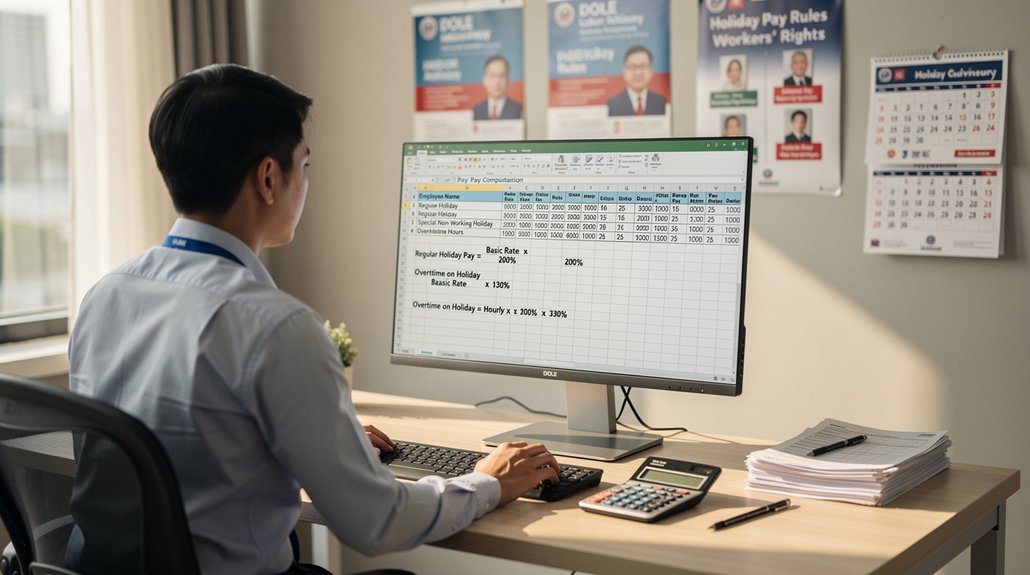
You’ll compute holiday pay by matching your employment status against Labor Code tiers. Non-working regular holidays pay 100% of your daily wage if you worked or took paid leave the day before; working the holiday earns you 200%, while overtime reaches 260% of your basic rate.
Special non-working holidays grant 130%, or 150% when falling on your rest day, with night differential adding 10% for qualifying hours. Check your payroll against these statutory multipliers, and you’ll see how additional scenarios stack premiums further.
Highlights
- Regular holidays grant 100% pay for non-working employees who worked or had paid leave the day before.
- Working employees on regular holidays receive 200% of their daily wage for the first eight hours.
- Special non-working holidays require prior scheduled work to qualify for 130% pay.
- Overtime on regular holidays pays 260% of the basic hourly rate, stacking with the night differential.
- Double holidays automatically grant 200% pay, increasing to 300% if work is performed.
Who Qualifies for Holiday Pay in the Philippines
Whether you’re a regular, probationary, or project-based employee covered by the Philippine Labor Code, you’re entitled to holiday pay—provided you’ve been present, on paid leave, or worked the scheduled day before a regular holiday.
- Your payroll eligibility hinges on this workday rule.
- For special non-working holidays, you’re disqualified if you didn’t work the immediately preceding scheduled day.
- Holiday accrual doesn’t apply to managerial staff, government employees, pure-contract freelancers, or workers unscheduled on the holiday—including part-timers on non-working days.
- You’re eligible regardless of whether your rest day coincides with the holiday, contingent upon meeting presence or preceding-day work requirements.
- These conditions determine your statutory entitlement, excluding redundant coverage and ensuring precise compliance with labor regulations governing compensated non-work periods.
- A missed contribution may trigger a 3% penalty that compounds monthly.
Regular Holiday Pay: 100%, 200%, and Double Holiday Rules
Once you’ve confirmed your eligibility under the workday rule, you’ll encounter three distinct compensation tiers for regular holidays.
Your wage calculation depends on whether you’re working or resting:
- Non-working employees: You’ll receive 100% of your daily wage, provided you worked the preceding day or were on paid leave.
- Working employees (first 8 hours): You’re entitled to 200% of your daily rate—double pay for holiday work.
- Overtime work: You’ll earn 260% of your daily wage (200% × 130% premium) for hours beyond eight.
When double holidays occur, two regular holidays falling on the same date, your holiday eligibility grants 200% pay even if you don’t work. If you do work, your wage calculation becomes 300% (200% holiday pay plus 100% for work performed).
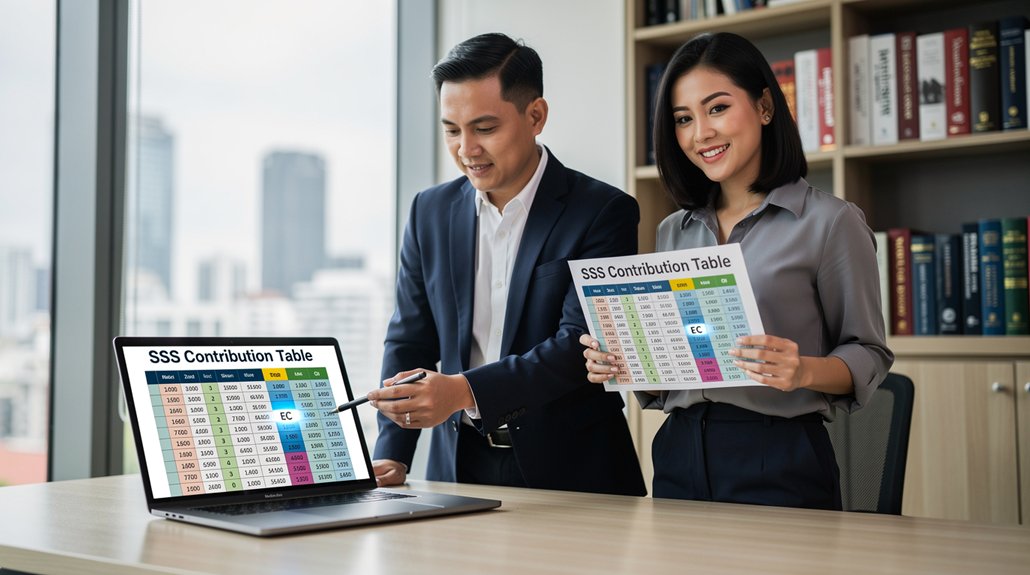
The SSS contribution rate for self‑employed workers is 15 % and influences their benefit eligibility.
Special Holiday Pay: 130% Rates and Rest-Day Calculations
If you’re scheduled to work on a Special (Non‑Working) Day, you’ll earn 130% of your basic daily wage for the first eight hours—so a ₱1,000 daily rate becomes ₱1,300. This 130% holiday premium represents your statutory entitlement for performing work on days designated as non‑working.
Your rest‑day calculations become critical when a Special Day coincides with your scheduled day off. In this scenario, your rate increases to 150% (₱1,000 × 1.50 = ₱1,500) for the initial eight hours.
Night differential applies when you render qualifying hours between 10:00 PM and 6:00 AM. You’ll receive an additional 10% of your hourly rate computed atop the 130% or 150% base, ensuring proper compensation for night‑time work performed during Special Non‑Working Days.
The SSS contribution ceiling of ₱35,000 affects payroll calculations for high‑earning employees.
Overtime and Night Shift Holiday Pay Explained
When you’re working extended hours beyond your regular shift on a holiday, your compensation stacks multiple premiums to reflect both the holiday designation and the overtime nature of your work.
- Regular holiday overtime pays 260% (200% × 130%) of your basic hourly rate
- Special non-working holiday overtime compensates at 169% (130% × 130%) of your basic rate
- When holiday overtime coincides with your rest day, rates escalate further—regular holiday rest-day overtime reaches 338% (200% × 130% × 130%)
Night differential adds 10% on top of any holiday overtime rate. For example, night work during regular holiday overtime yields 286% (260% + 10%). Special non-working holiday rest-day overtime with night differential compounds to 219% (130% × 150% × 130%).
The SSS contribution is calculated as 15% of the Monthly Salary Credit, plus an EC fee ranging from ₱10 to ₱30.
How to Check Your Holiday Pay for Errors
Before you file your next payslip away, take a moment to scrutinize your holiday pay line‑item against the statutory multipliers—because even automated payroll systems can miscalculate stacked premiums or overlook night‑differential add‑ons.
Cross‑check your daily rate against the correct percentage: 100% for non‑working regular holidays, 200% for working regular holidays, or 130% for special non‑working days. Verify that overtime stacks properly, regular holiday overtime demands 260% of your daily rate.
Confirm the night differential applies when you’ve worked 10 PM to 6 AM. Guarantee that statutory contributions and tax withholding align with your wage bracket. Conduct this payroll audit to protect your holiday eligibility and rightful earnings. Use accurate calculators to double‑check your results.
Frequently Asked Questions
Is Holiday Pay Taxable for All Employees?
Your taxable holiday isn’t automatic; entitlement criteria determine if you’re eligible. If you meet minimum workday requirements, holiday pay applies, but taxation follows standard income rules—no blanket exemption exists for all employees.
Do Probationary Workers Receive Holiday Pay?
You’re entitled to probationary benefits, including holiday entitlement, under the Labor Code. Your employer must pay you holiday pay even during probation, provided you’ve worked at least thirty days before the regular holiday.
Can Employers Require Work on Regular Holidays?
Yes, your employer can require you to work on regular holidays, provided they’re following a proper holiday policy. You’ll receive 200% of your daily rate. Verify payroll compliance by verifying that the correct premium pay appears on your payslip.
Are Part-Time Employees Entitled to Holiday Pay?
Yes, you’re entitled to holiday pay if you’re a part-time employee, provided you’ve worked for the employer within the month preceding the holiday. Your part-time benefits include holiday eligibility proportional to your daily work hours.
How Are Successive Holidays Calculated?
When you’ve got a successive holiday, you’re paid for both days even without working in between; however, overlapping pay rules prevent double compensation if the holidays fall on the same scheduled rest day.