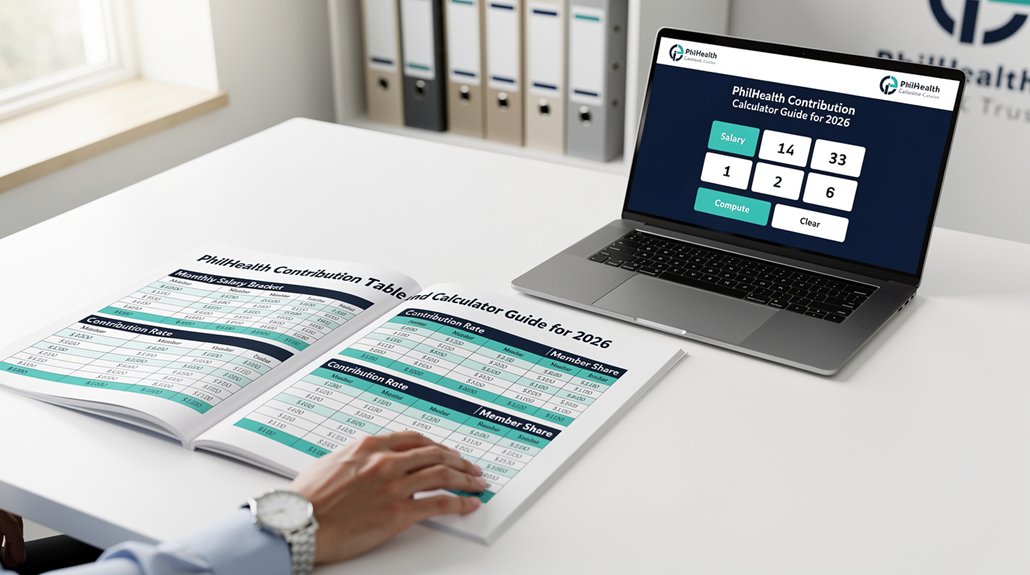


You’ll pay 5 % of your declared monthly taxable income to PhilHealth, with a PHP 500 floor and a PHP 5,000 ceiling, so a freelancer earning PHP 25,000 owes PHP 1,250 each month.
Register as a voluntary member by submitting two copies of the PMRF, IDs, and proof of income, then set up a PIN for online or wallet payments. Choose monthly, quarterly, semi‑annual, or annual schedules to avoid the 2 % or PHP 200 penalty, and you can even prepay up to 36 months. Keep your PIN and receipts handy, and you’ll discover more details on dependents, Wise integration, and FAQs.
Highlights
- Freelancers are voluntary contributors; premium equals 5 % of declared monthly taxable income, with a PHP 500 minimum and a PHP 5,000 maximum.
- Premium is calculated by multiplying income by 0.05, then applying the PHP 500 floor or PHP 5,000 ceiling as needed.
- Contributions can be paid monthly, quarterly, semi-annually, or annually; missed deadlines incur a 2 % or PHP 200 penalty, whichever is higher.
- Payment can be made online via the PhilHealth portal, GCash, Maya, or bank transfer, and offline at accredited banks and payment centers.
- Dependents up to five are covered at no extra cost; adding a sixth dependent triggers an additional supplemental premium.
What Is PhilHealth and Why Freelancers Need It
Because health insurance is a safety net, PhilHealth serves as the Philippines’ national program that covers everything from routine check‑ups to catastrophic care.
- As a freelancer, you’re a voluntary contributor, so you shoulder the full 5 % premium on declared income.
- That means a minimum of PHP 500 for earnings up to PHP 10,000 and a ceiling of PHP 5,000 once you hit PHP 100,000.
- Maintaining active contributions unlocks the same coverage benefits as salaried workers, including hospital stays, outpatient visits, preventive services, and even dependent coverage.
- Skipping payments isn’t a harmless shortcut; you’ll lose Freelancer health and incur a 2 % penalty (or PHP 200, whichever’s higher) that compounds monthly.
In short, a freelancer’s health hinges on consistent PhilHealth contributions.
The annual ceiling for contributions is PHP 100,000, after which the premium no longer increases.
Calculate the 5% PhilHealth Premium for Freelancers
How do you figure out the 5 % PhilHealth premium?
- First, take your declared monthly taxable income and multiply by .05.
- If the result falls below PHP 500, you pay the PHP 500 floor; if it exceeds PHP 5,000, you’re capped at that ceiling.
- For example, a PHP 25,000 income yields PHP 1,250 (5 % × 25,000).
- Remember, the premium is tax-deductible, so you’ll shave that amount off your taxable base when filing.
- Keep proof of income verification handy—PhilHealth may ask for recent invoices or bank statements.
- Choose a payment schedule (monthly, quarterly, semi‑annual, or annual); the rate stays the same, but late fees add a 2 % penalty or PHP 200, whichever’s higher, compounded each month.
- The 5 % premium applies uniformly to all contributors, regardless of employment status.
Register as a Voluntary PhilHealth Member (Step‑by‑Step)
After figuring out the 5 % premium, you’ll need to actually become a member. Voluntary enrollment is a paperwork sprint: grab two copies of the PMRF, two ID photos, and two IDs (or a PSA‑certified birth certificate). Add proof of income, latest ITR, financial statements, LGU certificate, or notarized affidavit; OFWs toss in a contract or visa.
Then choose ERSS online or the nearest LHIO/Express Outlet for member verification. Once the PIN lands in your inbox, lock in your payment schedule and keep the MDR fresh. It’s essential to maintain regular contributions to stay eligible for future PhilHealth benefits and loan eligibility.
| Step | Required Docs | Where to Submit |
|---|---|---|
| 1 | PMRF ×2, ID photos ×2 | ERSS or LHIO |
| 2 | 2 IDs or birth cert. | Same as above |
| 3 | Income proof | Same as above |
| 4 | PIN issuance | After verification |
| 5 | Payment setup | Portal, bank, e‑wallet |
Determine Your Freelance PhilHealth Monthly Premium
If you’re a freelancer, your PhilHealth premium is simply 5 % of your declared monthly taxable income, capped at a PHP 5,000 maximum and a PHP 500 minimum for earnings up to PHP 10,000.
- Calculate your average earnings, then apply the 5 % rule; if you earn PHP 8,000, you’ll pay PHP 400, but the law forces you up to the PHP 500 floor.
- For PHP 12,000, you’re at PHP 600, and once you hit PHP 100,000, the premium freezes at PHP 5,000.
- Submit your latest tax return or a notarized affidavit via the PhilHealth portal, then tap a digital wallet like GCash for instant payment.
- Remember, the government offers tax incentives for timely filings, so avoid the 2 % penalty that compounds monthly.
- Dependents ride on your record as long as you stay current.
- the 3 % monthly charge applies to overdue contributions, compounding each month.
Pick a PhilHealth Payment Frequency (Monthly‑ Quarterly…)
You can pick a premium option that matches your cash flow, whether you prefer the tidy rhythm of monthly dues or the convenience of quarterly lumps.
Schedule brings its own perks; monthly keeps you from the 2 % penalty trap, while quarterly cuts down on transaction processing fees. Just remember the deadlines, or the compounding penalty will bite.
The loan amount is based on the average of your twelve latest Monthly Salary Credits MSC and rounded up to the next higher MSC for a one‑month loan.
Premium Options
Choosing a payment frequency of monthly, quarterly, semi‑annually, or annually lets you align your PhilHealth contributions with your cash‑flow rhythm, but each schedule demands settlement by the last working day of the respective period.
You’ll notice the premium caps bite at PHP 500 and PHP 5,000, so your declared income dictates the exact amount.
- Monthly – 5 % of income, capped at PHP 5,000, due each month.
- Quarterly – Multiply the monthly figure by three, pay by March 31, June 30, September 30, or December 31.
- Semi‑annual – Double the quarterly sum, settle June 30 or December 31.
- Annual – Aggregate twelve months, pay by March 31 of the coverage year.
Pick the cadence that mirrors your invoicing, respect the caps, and avoid penalties.
Payment Scheduling Benefits
The premium caps and cash‑flow rhythm you just mapped out now dictate how each payment schedule protects you from interruptions: monthly contributions keep coverage continuously active but require constant bookkeeping, quarterly payments bundle three months of premiums into a single deadline, semi‑annual payments halve the number of due dates while still aligning with fiscal quarters, and annual payments let you settle everything once a year, freeing you from recurring reminders.
| Frequency | Due‑date rule | Penalty‑avoid tip |
|---|---|---|
| Monthly | Within same month | Set auto‑pay |
| Quarterly | Last working day of each quarter | Align with invoicing |
| Semi‑annual | Last working day of Q2 & Q4 | Prepay 6‑month block |
| Annual | Last working day of Q1 (coverage year) | Prepay 12‑month bundle |
| Prepay option | Up to 36 months anytime | Locks in payment timing, guarantees penalty avoidance |
Choose the rhythm that matches your cash flow, then lock it in; missed deadlines trigger a 2 % penalty or PHP 200, compounding monthly, so timing is everything.
Transaction Processing Fees
Since every PhilHealth payment—whether monthly, quarterly, semi‑annual, or annual—uses the same transaction‑fee structure on the online portal, e‑wallets, or accredited banks, you can pick any frequency without worrying about extra surcharges; the only cost difference comes from the timing of the payment itself, not the method.
The transaction fee stays flat, so your choice of payment frequency is a budgeting decision, not a hidden cost.
Here’s a quick recap:
- Monthly: pay by month‑end, avoid the 2 % penalty.
- Quarterly: settle by the last working day of each quarter.
- Semi‑annual: due at the end of Q2 and Q4.
- Annual: must be cleared by the first quarter’s end.
Pre‑pay up to 36 months in one go, dodge future penalties, and keep the fee unchanged.
Pay Your PhilHealth Premium Online or Offline
You can pay your PhilHealth premium online through the member portal, GCash, Maya, or a bank transfer, but if you prefer the old‑school route, any PhilHealth office, accredited bank, or Bayad Center will do.
Just have your ID, PhilHealth number, and proof of income ready, whether you’re clicking “submit” or handing over cash. After payment, you’ll receive an electronic receipt or a printed acknowledgment; there’s no need to chase a paper trail.
Remember that monthly contribution rates are based on your declared earnings and follow the same bracket system as SSS.
Payment Options
If you prefer speed, you can pay your PhilHealth premium online via the Member Portal, accredited bank transfers, GCash, Maya, or other e‑wallets, all in pesos and fee‑free; alternatively, offline options—PhilHealth offices, LHIO/Express Outlets, accredited banks, Bayad Centers, SM Bills Payment, and overseas partners like iRemit and Bank of Commerce—are available, though they may carry standard bank or remittance charges.
- Choose a digital wallet (GCash, Maya) for instant, fee‑free processing.
- Use the Member Portal for a clean, paperless transaction.
- Opt for an international remittance partner if you’re abroad; expect a modest charge.
- Visit a Bayad Center or SM Bills Payment for cash-handled convenience, remembering possible bank fees.
You can prepay up to 36 months, align payments with monthly or quarterly cycles, and avoid late penalties. Keep it simple, stay on schedule, and let the system do the heavy lifting.
Required Documents
Getting your PhilHealth premium sorted starts with the paperwork, whether you’re clicking through the Member Portal or standing in line at a Bayad Center.
- You’ll need two copies of the PhilHealth Member Registration Form, each with a 2‑ID photo, plus two valid government IDs or a PSA‑authenticated birth certificate.
- Toss in proof of income, latest ITR, financial statements, or a notarized income affidavit to satisfy freelancer tax and health eligibility compliance.
- For online payments, log in with your PIN and MDR, pick a schedule, and pay via bank transfer, GCash, Maya, or other e‑wallets.
- Offline, print the slip and head to any PhilHealth office, accredited bank, Bayad Center, or SM Bills Payment.
- Keep the issued PIN and MDR for coverage enrollment, membership renewal, and contribution tracking.
Confirmation Process
After you’ve submitted the required documents, the confirmation step kicks in: log into the PhilHealth Member Portal, hit “Pay Premium,” pick your frequency, and finish the transaction with a Philippine‑issued card or online banking; offline, just swing by any accredited collection center or partner outlet, flash your PIN, hand over the payment form, and snag the official receipt.
- Verify the portal shows your updated contribution status.
- Cross‑check the amount against the 5 % rate, minimum ₱500, maximum ₱5,000.
- Guarantee the payment gateway integration displays no error before you click “Confirm.”
- Keep the receipt for a payment history audit; you’ll need it if penalties accrue.
A quick glance at the “Contribution History” tab confirms everything’s in order, and any late‑payment penalty appears automatically.
Add and Manage Dependents on Your PhilHealth Record
Adding a dependent to your PhilHealth record is as simple as submitting a completed PMRF with the required IDs, either through the Member Portal or at any PhilHealth office. You’ll need the dependent’s ID, relationship proof, and a quick Dependent verification; the system then flags any Premium adjustments automatically. Remember, up to five dependents cost nothing extra, but the sixth triggers a supplemental premium.
Amendments must happen within 30 days, or claims get denied. Keep contributions current—missed payments suspend coverage for every listed dependent.
| Dependent Type | Age Limit | Premium Impact |
|---|---|---|
| Spouse | Any | None |
| Child (unmarried, unemployed) | < 21 | None |
| Disabled child | ≥ 21 | None |
| 6th+ dependent | Any | Supplemental |
| Removed/Updated | – | No effect if timely |
Avoid Late‑Payment Penalties and Interest
Keeping your dependents up‑to‑date is only half the battle; the other half is making sure every premium lands on time.
Late‑payment penalties bite hard: a 2 % charge or PHP 200 (whichever’s higher) compounds monthly, and interest keeps chewing at the balance until you clear it. Penalty avoidance isn’t a luxury, it’s a survival skill for freelancers who juggle cash flow.
Here’s a quick cheat sheet for penalty mitigation:
- Pay before the last day of the month via the PhilHealth portal.
- Set quarterly, semi‑annual, or annual deadlines on your calendar; treat them like client invoices.
- Use e‑wallets (GCash, Maya) for instant confirmation and zero‑miss risk.
- Consider a 36‑month advance to lock the rate and erase future penalties.
Integrate Wise for Seamless Overseas PhilHealth Payments
If you’re earning abroad, Wise lets you turn those foreign dollars into PHP at mid‑market rates with just a 0.33 % fee, then push the exact premium straight to any PhilHealth‑approved bank, GCash, or Maya, so you sidestep hidden remittance mark‑ups, lock in the 5 % contribution, and dodge the 2 % or PHP 200 monthly penalty.
Wise integration works like a backstage pass: you receive USD, GBP, AUD, etc., in a multi‑currency account, convert at a transparent 0.33 % (or one‑time 0.57 % for PHP), and dispatch the amount with a few clicks. The platform is BSP‑licensed (code 53‑0044‑00‑000), so regulators won’t raise eyebrows.
Schedule recurring overseas payments to match monthly, quarterly, or annual deadlines, and you’ll never scramble for cash. The result is a lean, automated pipeline that keeps your PhilHealth contributions on time without the usual remittance circus.
Freelancer‑Specific PhilHealth FAQs
You might think you need a corporate HR desk to qualify, but any self‑employed professional with a declared monthly income can join as a Direct Contributor – Voluntary.
Your premium is simply 5 % of that income, capped between PHP 500 and PHP 5,000, and you split the bill with the government, no employer share needed. The calculation is straightforward, so you can focus on your work instead of puzzling over formulas.
Eligibility Requirements
Because the Philippines treats freelancers as “self‑earning individuals,” you’ll need to register voluntarily, provide a valid PhilHealth PIN (or obtain one via the Member Registration Form), and declare your monthly taxable income; the premium is capped at PHP 500 for earnings up to PHP 10,000 and rises to PHP 5,000 for incomes of PHP 100,000 or more, based on the 5 % rate for 2025.
- Tax eligibility – you must be earning income that’s subject to tax; informal gigs don’t count.
- Income documentation – keep the latest ITR, financial statements, or a notarized affidavit ready for registration or any amendment.
- Dependents – add spouse or children only after your premiums are paid, and they’re recorded on your MDR.
- Payment timing – settle the premium within the covered month or face a 2 % penalty (or PHP 200, whichever’s higher) that compounds monthly.
Premium Calculation Methods
Having sorted out who qualifies, the next step is figuring out how your freelance earnings translate into a PhilHealth premium.
You’ll apply the 5 % rate to your declared monthly taxable income, but only within the premium tiers set by the agency.
If you earn up to PHP 10,000, you’ll pay the minimum of PHP 500; anything between PHP 10,001 and PHP 100,000 scales linearly—PHP 30,000 becomes PHP 1,500, for instance.
Once you hit PHP 100,000, the contribution caps at PHP 5,000, regardless of higher income.
Choose a payment schedule monthly, quarterly, semi‑annual, or annual, as long as you meet each deadline. Miss a deadline, and you’ll face a 2 % penalty or PHP 200, whichever’s higher, compounding monthly until you’re caught up.
Frequently Asked Questions
Can Freelancers Claim Philhealth Benefits While Working Abroad?
Yes, you can claim PhilHealth benefits abroad if you meet over‑tax eligibility, overseas coverage eligibility, and cross‑border contribution tracking; guarantee remote work health access, expatriate health entitlement, and international contribution compliance.
What Happens if Freelance Income Fluctuates Month‑To‑Month?
If your freelance income spikes or dips, you’ll need to adjust your contribution accordingly; the system recalculates each month, so irregular earnings trigger a proportional contribution adjustment.
Are There Discounts for Senior Freelancers?
You won’t find senior rates or age‑based discounts for freelancers; PhilHealth treats every contributor the same, regardless of how many birthdays you’ve celebrated.
How to Transfer Philhealth Contributions Between Different IDS?
You’ll need to file an ID migration request, then ask the office to process a contribution transfer. Bring your old and new IDs, proof of payment, and fill out the prescribed form.
Can I Pause Contributions During a Temporary Work Break?
You can request a temporary suspension during a temporary work pause, but you must file a formal request with PhilHealth and provide proof of the break; otherwise contributions keep accruing.